


The Four Foundations of Mindfulness
Click here to jump to talk playlist and an audio clip
In the summer of 1974, on the heels of the monumental first session of Naropa Institute in Boulder, Colorado, Chögyam Trungpa gave two back-to-back seminars on the Four Foundations of Mindfulness. These foundations are some of the Buddha’s most detailed teachings on the practice of mindfulness, which are found in the Satipatthana Sutra, “The Discourse on the Foundations of Mindfulness.” Trungpa Rinpoche presented these classic teachings in a unique way, emphasizing meditation practice as well as mindfulness in our daily life (what he brilliantly coined “meditation in action”). He also renamed three of the foundations to match his experiential presentation. The traditional translation “mindfulness of feeling” he changed to “mindfulness of life (or livelihood).” Likewise, “mindfulness of mind” became “mindfulness of effort” and “mindfulness of mental contents” became “mindfulness of mind.”
Chögyam Trungpa gave the first seminar, Foundations of Mindfulness (originally titled “Training the Mind”) at Rocky Mountain Dharma Center in Colorado. Many of the students were coming from either Naropa Institute or a month-long meditation retreat (dathun) and were especially inspired to dig deeper. Chögyam Trungpa observed in his opening talk: “This gathering is smaller in scale, but I feel this is a very potent group.” The thoughtful and clear questions about what he presented — the foundations, as well as the nature of mind and vipashyana — are proof that this was indeed a very tuned-in crowd.
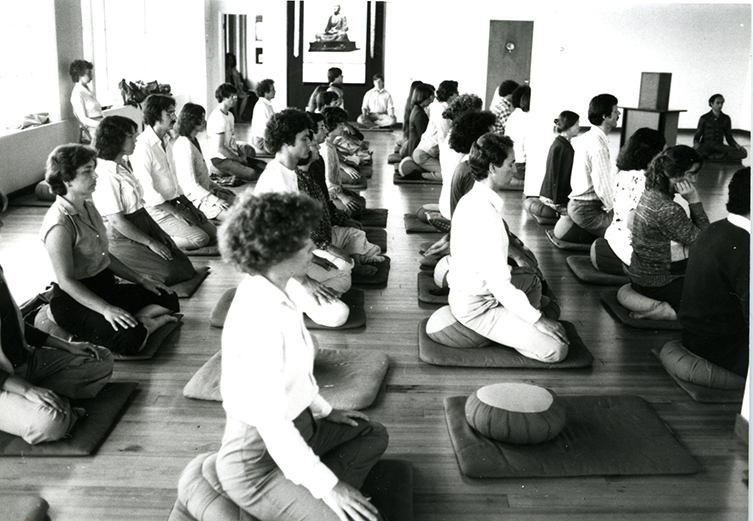
Shortly after this seminar ended, Chögyam Trungpa flew across the country and immediately began the second seminar, Techniques of Mindfulness, at his Vermont retreat center, Karmê Chöling. He again gave teachings on the nature of mind and the four foundations, but this time from a different perspective. Additionally, he gave guidance on balancing community life and solo practice, cultivating mindfulness off the cushion, and the risk of self-deception when teaching others.
Both seminars are approachable to anyone interested in mindfulness or Buddhist psychology. Chögyam Trungpa clearly mapped this traditional four foundations framework onto our mindfulness meditation experience and how that extends to daily life. Beyond meditation technique, he offered instruction on relating to common obstacles to mindfulness, such as our negative habitual patterns or resisting the meditation discipline.
Although there was no gap between the seminars, the presentation of each foundation in both is totally fresh. While he covered the same subject and followed the same arc (with different concluding talks), Trungpa Rinpoche used different language and metaphors, while emphasizing different concepts. For example, in the second seminar he took a more traditional approach, using philosophical language and technical Tibetan terms to explain the nature of mind. In his talks on mindfulness of life, he gave distinctly different instructions for the meditative technique of “touch and go”: the first time as panoramic awareness like rays of the sun, and the second time as being precisely on the dot, mindful of one thing at a time.
Perhaps this was in response to his dialogue with students in Colorado, or drawing from his wealth of knowledge to skillfully meet his students where they were — or he was also looking to the future so that people like us could have a more rich and nuanced understanding of the four foundations.
The Foundations of Mindfulness seminar is published as part of Chögyam Trungpa’s book Mindfulness in Action, an especially accessible introduction to mindfulness meditation and bringing awareness into everyday life.
Because the second seminar, Techniques of Mindfulness, is so clarifying, most of it was included in Volume One of the compendium of Trungpa Rinpoche’s seminary teachings (three-month group retreats), The Profound Treasury of the Ocean of Dharma. The last two talks of this seminar have never been published!
Mindfulness Playlist (Audio)
Foundations of Mindfulness (RMDC, Colorado, 1974)
- Talk 1: First Thought
- Talk 2: Mindfulness of Body: Appreciation
- Talk 3: Mindfulness of Life: Life Force
- Talk 4: Mindfulness of Effort: Spontaneous Discipline
- Talk 5: Mindfulness of Mind: Touching the Surface of Mind
- Talk 6: Vipashyana: Recollection
- Full seminar playlist