

Work, Sex, Money: Real Life on the Path of Mindfulness
Click here to jump to the talk playlists and an audio clip
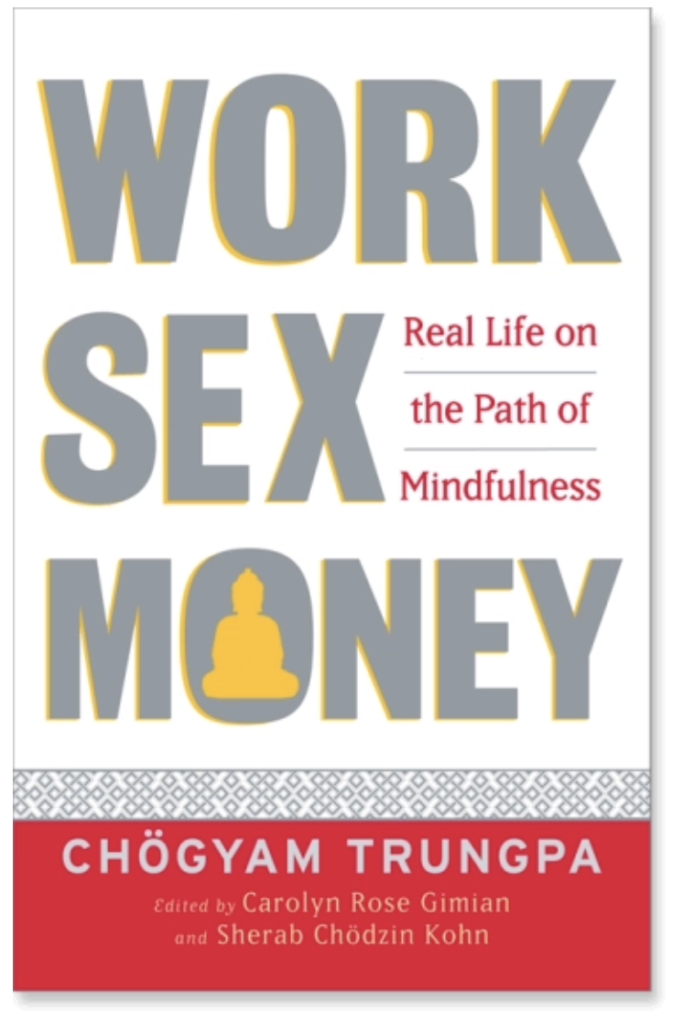
Now available in the Library is the full collection of seminars and talks that were the basis for Chögyam Trungpa’s book Work, Sex, Money: Real Life on the Path of Mindfulness. Co-editor of the book Carolyn Gimian introduces these teachings in the article below, composed of excerpts from the preface and afterword that she wrote for the book.
The Sacredness of Ordinary Life
Each day, we deal with the challenges of ordinary life: mundane experiences that could be summarized by the title of this book: Work, Sex, Money. We all hope these aspects of life will be a source of fulfillment and pleasure, and they often are. Yet, at the same time, we all have problems with these areas of our lives, and we search for practical advice and solutions to these concerns. … To cope with the anxieties and challenges of modern life, what we need is not temporary escape, because eventually we find ourselves back in the “real world.” The best prescription is a dose of reality and a dose of respect for ourselves and our world of work, sex, and money. Enter Chögyam Trungpa with a book that celebrates the sacredness of life and our ability to cope with its twists and turns with dignity, humor, and even joy.
Meditation in Action

Work, Sex, Money begins with several chapters that describe the general terrain of our discussion: problems in modern life with materialism on all levels—physical, psychological, and spiritual—and the need for formal meditation and a commitment to working with meditation in action, or applying meditative awareness to everyday life. Then Trungpa Rinpoche (Rinpoche is a title of respect that means “Precious One”) gets into the juicy details of work, sex, and money, with several chapters on each topic.The chapters on work are not just about the workplace and one’s career or profession. The author looks at general issues of conduct and discipline in everyday life as well as how the smallest action or everyday activity can be either an expression of simplicity and wakefulness or a source of chaos, pain, and confusion. The section on sex includes both a broad discussion on sexual energy and passion as well as discussion of relationships, communication, and relating sanely to family dynamics. In the section on money, Rinpoche looks generally at money as a form of energy. Chapters on the ethical approach to money and relating sanely to economics while being in business are included. The book concludes with two chapters on karma and panoramic awareness that tie together the whole discussion of a meditative or contemplative experience of everyday life.
Historical Context

In the 1970s, when the talks that form the basis of this book were given, Buddhism and the sitting practice of meditation were largely viewed, particularly in the West, as activities outside of the mainstream of everyday life. The idea of integrating mindfulness and awareness into ordinary activities was somewhat radical. Today, the application of mindfulness is being widely accepted as a helpful discipline in the management of pain; stress reduction; the treatment of depression, post-traumatic stress disorder, and other psychological problems; and in education, developing creativity—pretty much anywhere you look. In this volume, Trungpa Rinpoche talks extensively about why and how meditation and spirituality apply to work, sex, and money. Some of this may seem commonplace now, but at the time, it was an eye-opener for many in his audience. Today, people may think of the application of mindfulness to a specific problem as important, without necessarily wanting to adopt the bigger view represented by a tradition like Buddhism. Without proselytizing whatsoever or putting labels like “Buddhist” on the insights he offers, Chögyam Trungpa nevertheless presents the big view, the vast view, a view that transforms every moment and the whole of life.
An Editor’s Perspective
The editorial perspective I adopted for the editing of Work, Sex, Money was to look at what Rinpoche was saying from the perspective of universal wisdom, separated somewhat from its original cultural milieu. Put more bluntly, there were a lot of hippies and counterculture people in the audience in the early 70s. Rinpoche spoke absolutely directly to them. There was no sense of distance between him and them, but at the same time, he always addressed the larger view, speaking from the perspective of universal dharma and its applicability to any situation.
… While always seeing the larger view, he also spoke directly to the audience in the 1970s, responding intimately to the most personal queries. He had a gift for addressing minutiae and the cosmos at the same time. I don’t know how he did it, but you can see the results in both the original material and in the book. While there may be merit in the approach I took to the book, it is also enlightening and often entertaining to listen to the original source recordings. They are full of youthful vitality and spirit and show the unabashed lack of reticence of Trungpa Rinpoche’s students in asking him questions and commenting on the subject matter.

The Original Talks Included in the Book
Work, Sex, Money I (Boston, 1970)
This book [Work, Sex, Money] is primarily based on three seminars, each of which was entitled “Work, Sex, Money.” The first seminar was conducted at the East-West Center in Boston in September 1970, less than six months after Chögyam Trungpa arrived in the United States. Rinpoche gave one talk on sex, one on work, and the third on money.
Playlist:
- Talk 1: Sex: The Flame of Love and Pure Passion
- Talk 2: Work: Simplicity and Awareness
- Talk 3: The Question of Money
- Full seminar playlist
Work, Sex, Money II (Karmê Chöling, VT, 1971)
The second seminar took place in the summer of 1971 at Tail of the Tiger, a rural residential meditation center in Barnet, Vermont, that today is called Karmê Chöling. The seminar was a series of nine “events,” which consisted of lively discussions between speaker and audience, punctuated by Rinpoche’s remarks or short talks, some of which came at the end of several hours of questions and answers. The first few talks of this seminar were an introduction to the view of the importance of meditation in action in general, how karma operates and can be ultimately transcended, and the problems of materialism—physical, psychological, and spiritual—and how they affect our everyday experiences. Then Rinpoche conducted several discussions on each of the three themes of work, money, and sex. The entire seminar lasted ten days.
Playlist:
- Talk 1: The Sacred Society
- Talk 2: Karma
- Talk 3: The Nowness of Work
- Talk 4: Creativity and Chaos
- Talk 5: Overcoming Obstacles to Work
- Talk 6: Attitudes toward Money
- Talk 7: The Karma of Money
- Talk 8: Communication
- Talk 9: Panoramic Awareness
- Full seminar playlist
Work, Sex, Money III Playlist (Burlington, VT, 1972)
The third seminar, given in April 1972 in Burlington, Vermont, takes a slightly different approach to the material. The first talk describes the mechanisms of physical, psychological, and spiritual materialism and how these affect the normal course of work, sex, and money. The second talk looks at how the practice of sitting meditation and joining that with meditation in action can help us to begin to dismantle ego’s games. Finally, in the last talk, Rinpoche looks at how work, sex, and money are often an expression of klesha activity, or confused emotions, and how that approach can be overcome.
Playlist:
- Talk 1: The Myth of Happiness
- Talk 2: Meditation and Daily Life
- Talk 3: Passion, Aggression, Ignorance
- Full seminar playlist
The Ratna Society and ashoka Credit Union
Trungpa Rinpoche saw every activity in life as an opportunity to practice mindfulness and to realize one’s innate wakefulness. The more the potential difficulties, the more interested he was in an activity or an area. So he embraced the discussion of business and business ethics and took the opportunity to help infuse his students’ entrepreneurial spirit with decency and kindness.
The Ratna Society was a group of businesspeople in Boulder, Colorado, started by Chögyam Trungpa and his students. He gave four talks to the society over several years. The talks “Business Ethics” and “Regarding Money as Mother’s Milk” were used in Work, Sex, Money: Real Life on the Path of Mindfulness.
Another initiative to support economic activity in the community was the Ashoka Credit Union, which offered loans for business ventures and meditation retreats. Remarkably, the institution served the community from 1975 until 2022.
Playlist:
- Ratna Society: First Meeting (not included in the book)
- Ratna Society Meeting: Make Friends With Your Business (not included in the book)*
- Ratna Society Meeting: Business Ethics
- Ashoka Credit Union Fourth Annual Meeting (not included in the book)
- Ratna Society Meeting: Regarding Money as Mother’s Milk
- Full series playlist
*Published in The Collected Works of Chögyam Trungpa Volume 10, “Selected Writings”
Community Talks on the theme of work
In the early seventies in North America, Rinpoche held community talks with students at both Karmê Chöling and in Boulder frequently, weekly at times. He invited others to give some of these talks as well. I’ve spoken with a number of students who attended these early community events, especially the talks in Boulder. They light up and show a great fondness when speaking of this era and these events.
Playlist:
- Work (Boulder, 1972) (not included in the book)
- Work (Karmê Chöling, 1974) (not included in the book)
Sources
This article is composed of excerpts from Carolyn Gimian’s Editor’s Preface and Editor’s Afterword to Work, Sex, Money: Real Life on the Path of Mindfulness by Chögyam Trungpa. (Shambhala Publications, 2011.)
Descriptions of The Ratna Society and Community Talks are excerpts from Carolyn Gimian’s Introduction to The Collected Works of Chögyam Trungpa, Volume 10. (Shambhala Publications, 2017.)
Inspired by these teachings? Consider making a donation. Support our work here!