


Click here to jump to the playlists and here for an audio clip.
One might say that the study of the abhidharma is a theoretical one in some sense; but it also has the quality of personality, individuality, because the abhidharma is a survey of the psychology of the human mind. It is part of the basic philosophy of Buddhism, common to all schools.
Chögyam Trungpa’s introduction to his book Glimpses of Abhidharma
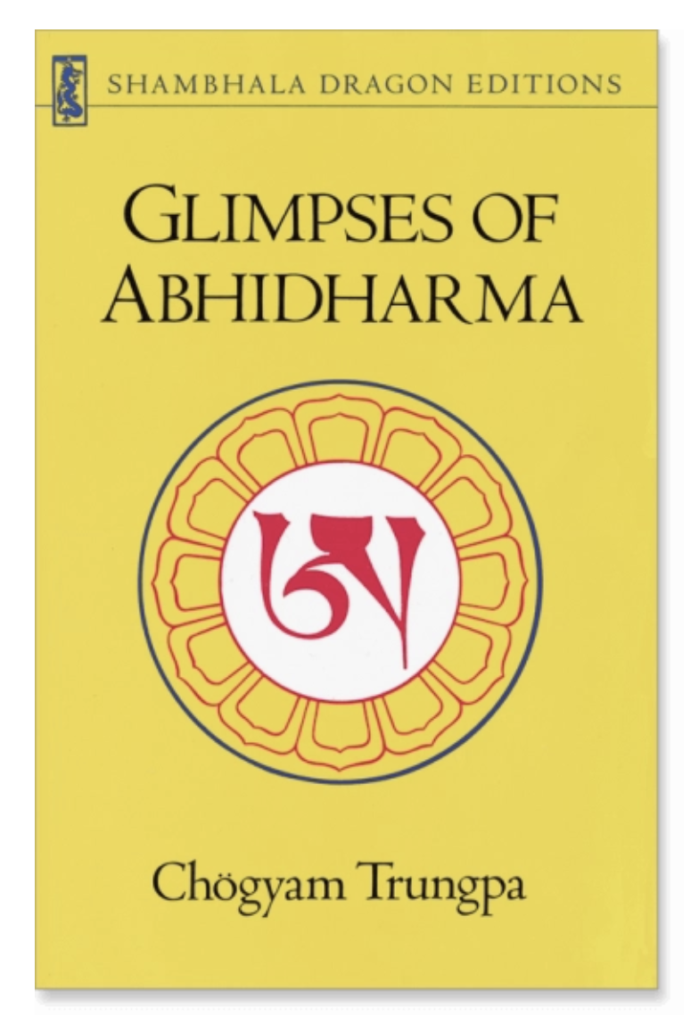
The article below is excerpted from Chögyam Trungpa’s introduction to his book Glimpses of Abdhidharma (1975, originally titled Abhidharma). The book was edited from a single seminar titled Abhidharma that Trungpa Rinpoche gave at Karmê Chöling, Vermont, in 1971. All nine talks from that seminar, including the one edited into the book’s introduction, appear in the playlist that follows the article, which maps each chapter of the book to the talk upon which it is based. This Digital Library collection also features two seminars on abhidharma not included in the book: the previously unpublished nine-talk seminar Psychology of Samsara and Nirvana (Boulder, CO, 1972); and the five-talk seminar Discovery of Egolessness (NYC, 1976), which appears in edited form in the book Mindfulness in Action (2015). Scroll down to learn more about these seminars and access the playlists.
Excerpts from Chögyam Trungpa’s Introduction to Glimpses of Abhidharma
Introducing the Abhidharma
The abhidharma is perhaps regarded as dry and scholarly, theoretical. We will see. In any case I would like to welcome those of you who are brave and willing to go into it. To a certain extent you are warriors.
I have decided to present the abhidharma because I feel it is necessary in studying the Buddhist tradition to start from scratch, to begin at the beginning and present the pure, immaculate, genuine teaching. We have been doing that so far in terms of the practice of meditation and in terms of the theoretical understanding of the teaching as well. I feel it is important that the teachings be presented that way. The presentation of Eastern teachings in the West has been particularly haphazard. The teachers have something to say and they say it, but perhaps it does not reach the audience effectively, in such a way as to create the right situation for practice. These teachers have been trained and have practiced and received transmission in their own countries, but that was a different cultural situation in which a certain environment of discipline was taken for granted. They seem to presume that the same cultural background also exists in the West. But perhaps that is not the case. So for us in the West to get into a spiritual teaching, we have to get into the basic core of it. We have to build a really good foundation before we get into practices such as the yoga of inner heat or start levitating or whatever.
Joining Intellect and Intuition
In getting back to the basic principles, there could be two approaches. Some people feel inclined to work purely on the intuitive or emotional level; others feel that approach is not fundamental enough and want to work on the scholarly or theoretical aspect. I would not say that these two ways conflict, but rather that they are two channels through which to approach the subject. What we are trying to do here is to neglect neither the intellect nor the intuition, but to combine the two together. A real understanding of the teachings must be an intellectual one and a human one at the same time. The intelligent aspect is the theory; the human side is the intuitive, personal feeling of the teaching and the learning process involved in it. One might say that the study of the abhidharma is a theoretical one in some sense; but it also has the quality of personality, individuality, because the abhidharma is a survey of the psychology of the human mind. It is part of the basic philosophy of Buddhism, common to all schools—the Theravadins, the Tibetans, and so on.

The Tripitaka
The abhidharma is part of what is called the tripitaka, the “three baskets” or “three heaps.” These are the three bodies of the teaching that constitute the Buddhist scriptures. The first is called the vinayapitaka, which is concerned with discipline, the practicalities of how to live one’s life in the world and understand it at the same time. The vinaya is presented in such a way that there is no conflict between understanding and practical discipline. The second “basket” is the sutrapitaka which deals with certain meditative practices and various ways of training the mind, ways of accepting and using both intellect and intuition as supports of meditation. The third is the abhidharmapitaka. Having seen the practical aspect of how you relate to the world and also the meditative, psychological aspect, we now begin to work on the background of the whole thing. This is almost, one might say, preparation to teach. The abhidharma in a sense tells us how, having understood everything, to communicate with others.
Many modern psychologists have found that the discoveries and explanations of the abhidharma coincide with their own recent discoveries and new ideas; as though the abhidharma, which was taught 2,500 years ago, had been redeveloped in the modern idiom.
The Five Skandhas
The abhidharma deals with the five skandhas. The skandhas represent the constant structure of human psychology as well as its pattern of evolution and the pattern of evolution of the world. The skandhas are also related to blockages of different types—spiritual ones, material ones, emotional ones. An understanding of the five skandhas shows that once we are tuned into the basic core of egohood, then anything—any experience, any inspiration—can be made into a further blockage or can become a way of freeing ourselves. Abhidharma is a very precise way of looking at mind. Any tendency of mind, even the subtlest suggestion of a tendency can be viewed with great precision—even something as slight as the irritation from having a fly perched on one’s leg. That irritation, for example, might be classified as a friendly one which merely tends to frighten the fly away or an aggressive one which moves to kill it.
Meditation in Action
The abhidharma deals very precisely and impartially with our particular type of mind and it is tremendously helpful for us to see our mind that way. This does not mean being purely scholarly and intellectual. We can relate to little irritations like the one of the fly as just the sort of happening that makes up the human situation. We do not particularly make a big deal about it, but we see it precisely. This eventually becomes very helpful. It is helpful not only for pure meditation but also meditation in action. The whole approach of Buddhism is oriented towards dealing with everyday life situations rather than just meditating in order to attain enlightenment. Throughout the three pitakas there is very little emphasis on enlightenment. The pitakas are handbooks of how to live in terms of the awakened state of mind, but very much on the kitchen-sink level. They are concerned with how to step out of our usual sleepwalking and deal really with actual situations. The abhidharma is a very important part of that general instruction.
Our particular study here of the abhidharma, because of limitations of time and space and the patience of the audience, has to be something of a rough survey. Nevertheless, as a basic introduction, I think it will be extremely useful.

Glimpses of Abhidharma Playlist
How it works: This book-to-talks playlist is listed by chapters just as they are in the book Glimpses of Abhidharma. Across from the title of each chapter is the link to the audio recording of the original talk. Click on the talk title to listen to the recording. The entire book is based on the seminar Abhidharma (Karmê Chöling, VT, 1971).
Note: While the book is based on these talks, the presentation of the material in the original recordings may differ from the final published versions. This is to be expected when a book is based on oral presentations.
Book Chapter. . . . . . . . . . . . . . . . . . . Link to Original Talk
- Introduction . . . . . . . . . . . . . . . . . . . . . Abhidharma Seminar, Talk 1
- Form . . . . . . . . . . . . . . . . . . . . . . . . . . . . Abhidharma Seminar, Talk 2
- Feeling . . . . . . . . . . . . . . . . . . . . . . . . . . Abhidharma Seminar, Talk 3
- Perception . . . . . . . . . . . . . . . . . . . . . . Abhidharma Seminar, Talk 4
- Intellect . . . . . . . . . . . . . . . . . . . . . . . . . . Abhidharma Seminar, Talk 5
- Meditation . . . . . . . . . . . . . . . . . . . . . . . Abhidharma Seminar, Talk 6
- Consciousness . . . . . . . . . . . . . . . . . . Abhidharma Seminar, Talk 7
- Auspicious Coincidence . . . . . . . . Abhidharma Seminar, Talk 8
- Practice and Intellect . . . . . . . . . . . Abhidharma Seminar, Talk 9
More Seminars on Abhidharma
PSYCHOLOGY OF SAMSARA AND NIRVANA (BOULDER, CO, 1972. AUDIO.)
In this previously unpublished nine-talk seminar on abhidharma, Trungpa Rinpoche presents the twelve nidanas (chain links of dependent origination), the three kaya principle, and the five sambhogakaya buddha family principles (vajra, ratna, karma, padma, and buddha).
Playlist:
- Talk 1: First Nidana: Three Kinds of Ignorance
- Talk 2: Second Nidana: Samskara
- Talk 3: Nidanas of Consciousness, Name and Form, Six Senses
- Talk 4: Nidanas of Contact, Feeling, Craving, Grasping
- Talk 5: Nidanas of Becoming, Birth, Old Age and Death
- Talk 6: The Trikaya and the Five Buddha Families
- Talk 7: Vajra and Ratna Families
- Talk 8: Padma and Karma Families
- Talk 9: Buddha Family
- Full seminar playlist
Discovery of Egolessness (NYC, 1976. AUDIO.)
This five-talk seminar, given in New York City in 1976, discusses the five skandhas (aggregates) as the building blocks of ego. These talks were the basis for several chapters in Trungpa Rinpoche’s book Mindfulness in Action (2015).
Playlist:
AUDIO CLIP
Inspired by these teachings? Consider making a donation. Support our work here!